
Unlock Energy Savings With Commercial Window Tinting
Commercial window films are thin retrofit coatings applied to glazing that control solar heat gain, reduce glare, and improve building energy performance. By altering how glass interacts with the solar spectrum—rejecting infrared, reflecting ultraviolet, and sometimes insulating against heat loss—these films can lower HVAC runtime and produce measurable cooling and heating savings. In this article you will learn the physical mechanisms (SHGC, U-value, VLT), the main benefits for occupant comfort and asset protection, which film technologies suit common commercial scenarios, and realistic ROI expectations for property owners. Many businesses face high cooling bills and uneven interior temperatures; properly specified commercial solar window film and heat-blocking window film solutions can be an economical retrofit that addresses those pains. We’ll also show how to estimate savings, compare film types, review incentive pathways, and explain practical next steps for implementation.
How Do Commercial Window Films Save Energy in Buildings?
Commercial window films save energy by reducing the Solar Heat Gain Coefficient (SHGC) of existing glazing, lowering the amount of solar infrared energy that enters conditioned space. By blocking or reflecting heat before it becomes interior load, films shorten HVAC run times and decrease peak cooling demand, which translates into lower kWh consumption and reduced utility bills. Films can also improve glazing insulation (effective U-value improvements) by adding a low-emissivity surface that reduces radiant heat transfer, helping in both cooling and heating seasons. Together, heat rejection and improved insulation reduce temperature stratification and HVAC cycling, producing both operational savings and improved equipment lifespan. Understanding these mechanisms leads directly to practical impact estimates and the best film choices for different façades.
What Is Solar Heat Gain and How Does Window Film Control It?
Solar heat gain is the portion of solar radiation that becomes interior heat through windows, commonly expressed by SHGC; lower SHGC means less heat enters a building. Window films control solar heat gain through selective reflection, absorption, and transmission: spectrally selective films reflect infrared while allowing visible light; metalized and ceramic coatings absorb or reflect parts of the spectrum; and Low-E films reduce emissivity to slow radiant heat transfer. In practice, applying a high-performance film can cut cooling loads by roughly 10–30% on sun-exposed facades, depending on orientation and glazing area. This reduction directly lowers peak HVAC demand and stabilizes indoor temperatures, making film a cost-effective retrofit for many commercial buildings.
How Does Reducing HVAC Load Lower Energy Costs?
Reducing HVAC load lowers energy costs by reducing runtime and peak demand charges, and by increasing system efficiency through steadier operating conditions. Shorter runtime reduces kWh consumption; lower peaks can reduce demand charges in commercial tariffs and improve HVAC part-load efficiency, which often yields nonlinear savings beyond simple runtime reduction. Fewer on/off cycles also reduce wear on compressors and controls, translating into deferred maintenance and replacement costs. These operational benefits compound with energy savings to improve total lifecycle economics and justify retrofit investment in many climates and building types.
What Are the Key Benefits of Commercial Window Tinting for Energy Efficiency?
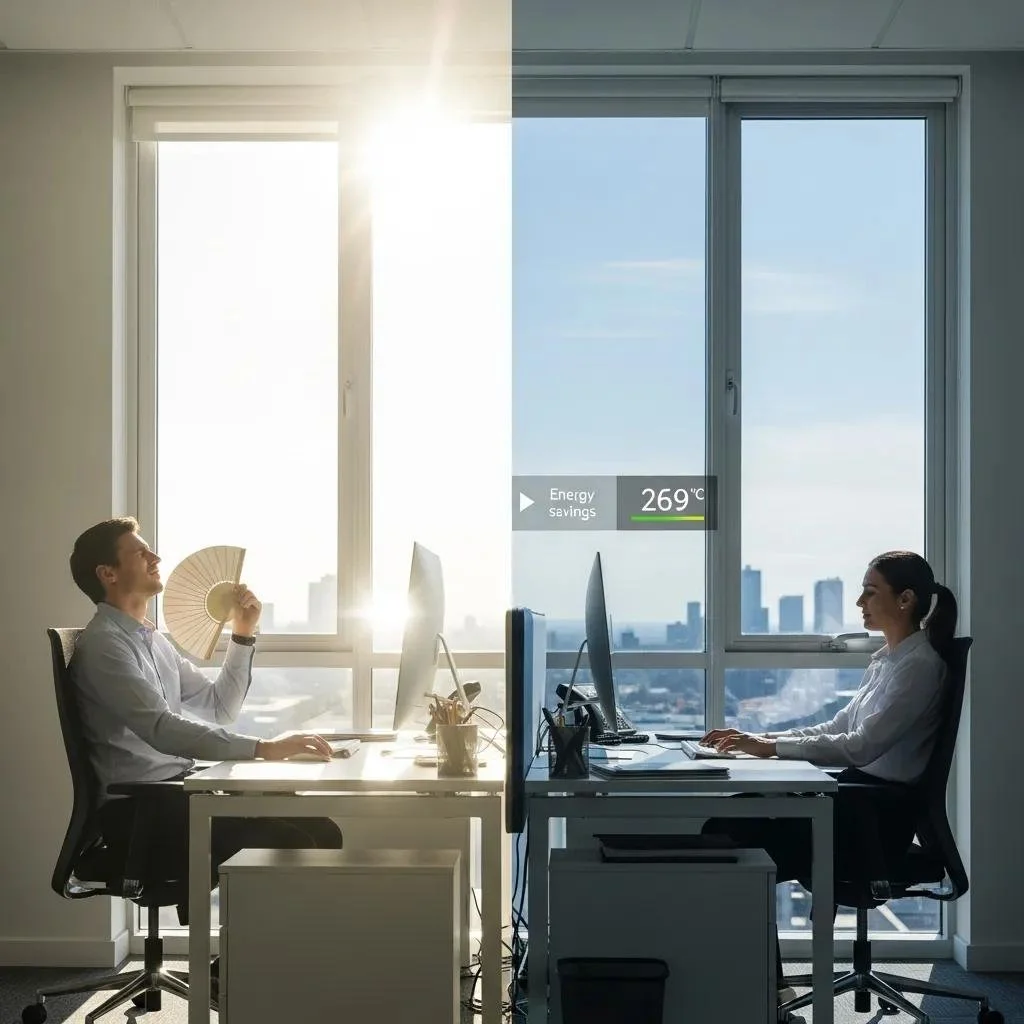
Commercial window tinting delivers multiple, synergistic benefits: lower cooling energy, improved occupant comfort through reduced glare and temperature swings, UV protection that extends interior asset life, and enhanced exterior appearance. Films can simultaneously lower SHGC while preserving or controlling Visible Light Transmission (VLT), enabling daylighting strategies that reduce electric lighting loads. The combination of reduced solar gain and UV blocking also protects furnishings and reduces fading, which preserves asset value and lowers replacement costs. These benefits support productivity and wellbeing while delivering clear operational savings, so building owners should weigh comfort and preservation alongside pure energy metrics when evaluating film options.
Before the comparative table below, here is a quick list summarizing the primary energy and comfort benefits:
Reduced cooling demand: Films lower solar heat entering conditioned spaces and reduce HVAC runtime.
Improved occupant comfort: Controlled VLT and heat rejection minimize glare and hot spots near windows.
UV protection and asset preservation: Films block UV to limit material fading and degradation.
These benefits make window film an attractive retrofit; the table that follows breaks down mechanisms and typical quantified impacts.
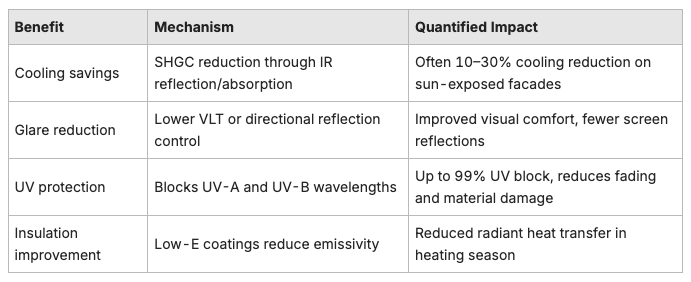
This table highlights how distinct mechanisms map to real building impacts and why combining film selection with glazing orientation analysis is critical for accurate savings projections. The next section reviews film technologies that deliver these mechanisms.
After outlining benefits and mechanisms, Commercial Film Solutions can provide practical implementation via their Commercial Solar Window Film and heat-blocking window film solutions to help businesses apply these advantages on real projects; this description aligns with our intent to promote services while keeping the focus on measurable savings and specification guidance.
How Does Window Film Improve Occupant Comfort and Glare Reduction?
Window film improves occupant comfort by evening out interior temperatures and by controlling visible light transmission to reduce glare on workstations. VLT (Visible Light Transmission) measures how much visible light passes—films can be chosen to maintain daylight while cutting glare, preserving natural light benefits for productivity. By lowering localized solar gain near windows, films eliminate hotspots and reduce HVAC balancing problems, creating more consistent occupant comfort across zones. Choosing the right VLT and spectrally selective performance is key to balancing daylighting, glare control, and energy savings for a given space and orientation.
What UV Protection Advantages Do Commercial Window Films Offer?
Commercial window films block a large share of damaging ultraviolet radiation, protecting furniture, finishes, and stored materials from fading and breakdown. Many high-performance films advertise UV blockage approaching 99%, which slows degradation of textiles, wood, plastics, and artwork. This asset-preservation effect reduces replacement and refurbishment cycles and lowers lifecycle costs for interior finishes. For businesses where brand image and interior longevity matter—retail, hospitality, healthcare—UV protection is a measurable value alongside energy and comfort improvements.
Which Types of Energy-Saving Commercial Window Films Are Best for Businesses?

Commercial projects require matching film properties to building goals: Low-E films focus on emissivity and insulation; spectrally selective films maximize IR rejection while preserving visible light; ceramic films offer durable, non-metalized performance with stable optical properties. Each technology presents trade-offs in SHGC reduction, VLT retention, and emissivity improvements, so selection depends on orientation, existing glazing spec, and whether daylighting is a priority. For south- and west-facing glazing, spectrally selective or heat-blocking films often yield the best cooling-first returns, while Low-E films help when heating season performance matters. Understanding these trade-offs guides optimized specifications for energy, comfort, and appearance.
Below is a concise comparison of common film types and recommended use-cases.
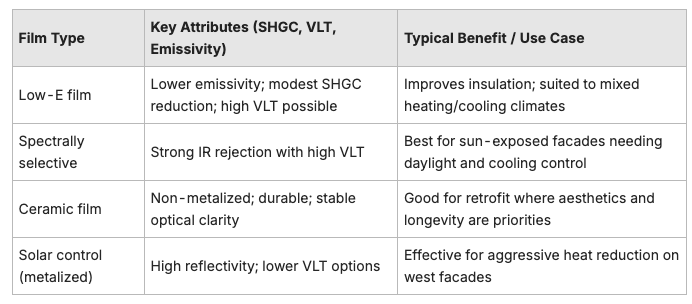
This comparison helps facility managers choose the film type that aligns with their energy and occupant objectives. For projects requiring installation and specification help, Commercial Film Solutions recommends beginning with a site audit and energy measurement to tailor a film selection that meets performance goals; this guidance follows our intent to promote services while keeping educational priorities first.
How Do Low-E, Spectrally Selective, and Ceramic Films Differ in Energy Performance?
Low-E films reduce emissivity to improve glazing insulation and help in climates with significant heating loads, often improving U-value performance more than pure solar rejection films. Spectrally selective films are engineered to reject IR while allowing visible light, giving strong cooling reductions without darkening interior spaces. Ceramic films are engineered for durability and color stability, offering consistent performance without metal interference in wireless signals or aesthetics. Choosing among these depends on whether the primary target is cooling load reduction, daylight preservation, durability, or a combination of objectives.
What Are the Top Commercial Window Film Brands for Energy Efficiency?
Industry-recognized manufacturers produce a range of high-performance films validated by technical datasheets and warranties; examples include manufacturers known for energy-focused product lines such as 3M, Eastman (Hanita Coatings), and Madico. Brand selection affects available SHGC/VLT combinations, warranty terms, and certification support for incentives. Rather than endorsing a single brand, building owners should review manufacturer performance curves and warranty conditions and consult installers for brand-specific recommendations based on project goals.
What Is the Return on Investment for Commercial Window Film Installation?
Typical payback periods for energy-focused commercial window film installations frequently fall in the 1–3 year range for sun-dominant façades, with variations driven by climate, glazing area, energy costs, and film choice. Savings derive from reduced cooling kWh, lower demand charges, and extended HVAC life; combining these with available rebates often shortens payback. Below are example scenarios to help estimate project economics quickly and concretely.
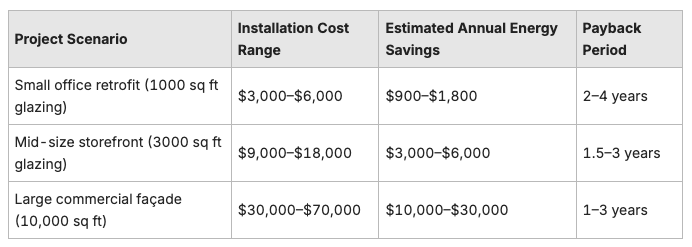
This ROI table uses conservative estimates and illustrates how scale and energy rates drive faster payback on larger, sun-exposed projects. For site-specific projections, an energy audit with measured kWh and demand profiles produces more accurate returns.
How Quickly Can Businesses Recoup Costs Through Energy Savings?
Businesses often recoup film installation costs within 1–3 years on projects where cooling dominates energy use and where significant glazing faces south or west. A simple sample calculation: a $15,000 installation that reduces annual cooling costs by $5,000 yields a 3-year payback; adding rebates or demand-charge reductions can shorten this timeline. Variability arises from local tariff structures, building occupancy patterns, and existing HVAC condition, so precise estimates require measured baseline energy use. Interested owners should request a tailored audit to refine these numbers.
Are There Utility Rebates or Incentives for Installing Energy-Efficient Window Films?
Utility rebates and incentives commonly exist for energy-efficiency retrofits and may cover part of film installation costs, offered through local utilities, state programs, or commercial energy-efficiency initiatives. Incentive availability depends on program rules, film performance specs, and pre-approval or post-installation verification, and can materially improve payback. Building owners should consult local program databases or an energy auditor to identify eligible incentives and ensure the project meets documentation and performance requirements.
As a practical next step, Commercial Film Solutions can assess glazing, model expected savings, and provide installation estimates for Commercial Solar Window Film and heat-blocking window film solutions; this operational support is offered to help building owners convert technical savings potential into deliverable outcomes while we continue to promote services aligned with measured energy goals.
Key steps to move forward include:
Conduct a glazing and energy baseline audit to quantify current loads and exposures.
Compare film options (SHGC, VLT, emissivity) against performance targets and daylighting needs.
Evaluate rebate opportunities and request a vendor estimate to finalize ROI.
For a project estimate or site assessment, Commercial Film Solutions offers a Free Energy Savings Estimate to help owners quantify potential savings and next steps without obligation.